
 Do you recall the White Rabbit in Lewis Carrols, Alice in Wonderland? You know the jumpy little guy who was always crying out, “I’m late, I’m late, for a very important date.” He was so worried about being in the right place at the right time. He had so much on his plate.
I don’t know about you, but I have lived the life of that rabbit. I have spent time hopping from one thing to another always with the feeling that I am not quite where I should be; I am not measuring up. Busy-ness became a habit. I was mired in the thick of thin things.
Mothers and fathers find themselves here all the time. All the chores belong to parenting: cooking, cleaning, yard work, laundry, dishes, getting kids up, putting them to bed, running kids here and there.
And then there are all the good things that we can do for ourselves to feel successful. We do them to serve in our community. We do them because we want our kids to have a good example. You know the stuff: serving in church, PTA, community events, Boy Scouts, Girl Scouts, youth choirs, charity organizations.
It can all feel so exhausting. And yet aren’t these all good things. Yup. They are. But I try to remember what Stephen R. Covey explained. It is important not to sacrifice the best for the sake of the good.
So, what is best?
Our family, with its relationships, should be right at the top of the list.
It’s wonderful to drive your child to sports practices, to lessons and other worthy events. But it could be best to sit for 3 minutes on their bedside at night and listen to them.
It’s valuable to take your family to a movie or a water park or other fun venue. But it might be better to sit at the dinner table for 15 minutes engaged in a mini conversation.
Laundry, clean counters, and bedrooms all matter and must be done. That is good. But it might be better to learn how to engage during chores in a way that strengthens the relationship and doesn’t just get the work done.
It’s valuable to show our children how to serve by leading groups and organizing community events. It might just be better to send the same message by learning to be more Present at home: actively listening to them when they come home late in the evening or putting down your phone to look them in the eye when they need you.
I am not saying that we shouldn’t serve in our communities and church. I am not saying that we shouldn’t go places, do things as a family. I am not saying that lessons and organizations aren’t important.
Here is what I am saying. Time at home, serving each other and being Present just might be BEST.
If being home doesn’t feel nurturing or successful to you right now, then maybe you need a tweak in how you see the everyday events that happen there. If chores, bedtime, and meals are points of contention then maybe you need to learn how to use them for connection.
When we understand that connecting with our family members should be top on our list, when we know the difference between good and best, then we will feel more successful in our homes and we will have more satisfaction in our lives.
Unlike the White Rabbit, you can stop hopping from place to place wondering if you are in the right place. You are at home. You are with your family. You are in the best place!
Learn how to STOP being the White Rabbit
If you want that tweak in how you see what you do at home, if you want to turn points of contention into points of connection, get your FREE copy of Chapter four from the book Becoming A Present Parent: Connecting with your children in five minutes or less HERE.




 I’ve been married to the same man for 48 years. We celebrated this milestone in May of 2019. This has caused me to pause and contemplate the last fifty-one years. That’s how long I’ve known my husband, Don. I fell in love with him because he was handsome and romantic. One day he showed up at my door with a car full of roses. He had cleaned out a street vendor! But that isn’t why I’ve stayed with him.
 me. He often goes out of his way to do something he knows I need to have done. He looks at me when I am talking to him. He takes the time to listen. He doesn’t always get what I am saying but he listens and tries. : ) He often puts his needs ahead of mine.
 There is a space between stimulus and response. Sometimes it’s so narrow that you would swear it isn’t even there. But it is and you can learn to recognize the moment of choice. You will still respond poorly for a time, but eventually, that space between stimulus and response will get wider and you will have time to choose a better response. I promise this is true!


 One of my sisters decided to finish her basement and hired another sister and her husband to do the job. It’s important to know that they aren’t contractors but thought they could do the job. My sister, Nanette, went to Google to learn how it was done. She estimated that it would take them about two weeks.
 whether my sister should have said yes. It’s more a question of what my sister wanted.



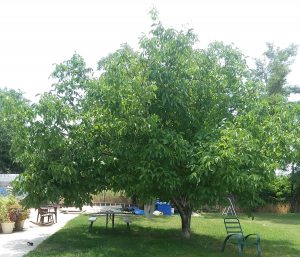 There’s a tree in our back yard that is growing faster on one side than on the other. The other morning my daughter gave me her impression as to why this tree is so lopsided.
 we could I built garden boxes for my patio and I’ve tended them with loving care. I feed them and I prune them. I deadhead the flowers every day, so they’ll keep blooming. I water. I am consistent.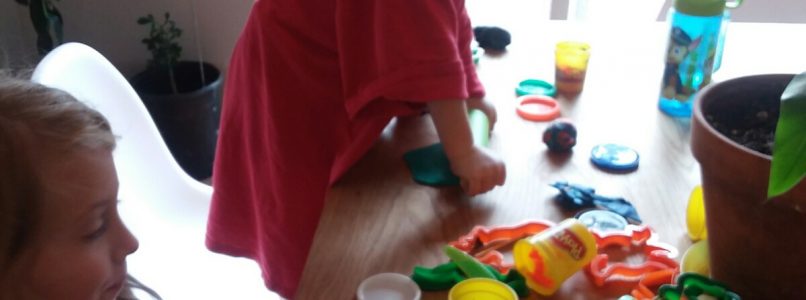
 comes with summer. BUT summer can be a very busy time. Sometimes the pace outstrips my ability to keep up.
 the winter with the free range chickens. Then totally covered over early spring until the chicken run was done and they were contained.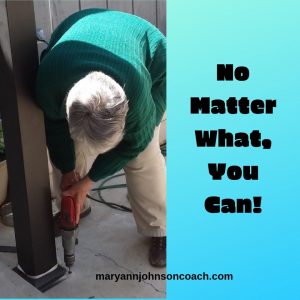
 daughter’s family. New babies are so wonderful! I helped them landscape the front yard. Whew, that was a lot of work. They waited until I got there because they had this idea that I know a lot about plants, how they grow, how to design gardens, etc. Yikes! It was a real adventure at the greenhouse picking everything out. It was an even greater adventure designing and planting everything. However, it turned out great and we got some good together time in the bargain.
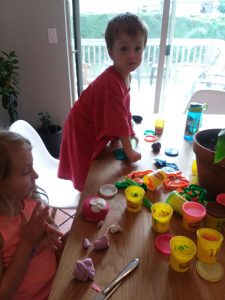 front door. The kids LOVED that. I learned all about play dough and the wonderful things that kids can create. : ) Then we moved on to bubble snakes. We also built and exploded a volcano because Elliott like everything prehistoric.
 Here is the definition of shame – a painful feeling of humiliation or distress caused by the consciousness of wrong or foolish behavior.
 Every parent is made up of a measure of good,